From Idea to Delivery in One Thread: What We’re Building at MeetAndy
Personal AI makes each role faster. MeetAndy brings product insights, planning, implementation, and feedback into one thread so the whole team can move faster together.
Read this article in Chinese: 中文版:從想法到上線,都在同一個討論串裡
Codex and Claude Code have made engineers faster. But for many teams, product delivery has not sped up at the same rate.
The bottleneck is in the handoffs between product, design, engineering, and QA.
In my previous article about Aria (in Chinese), I wrote about how a personal AI assistant connects my calendar, contacts, news, research, and writing. What Aria learns from one task becomes context for the next.
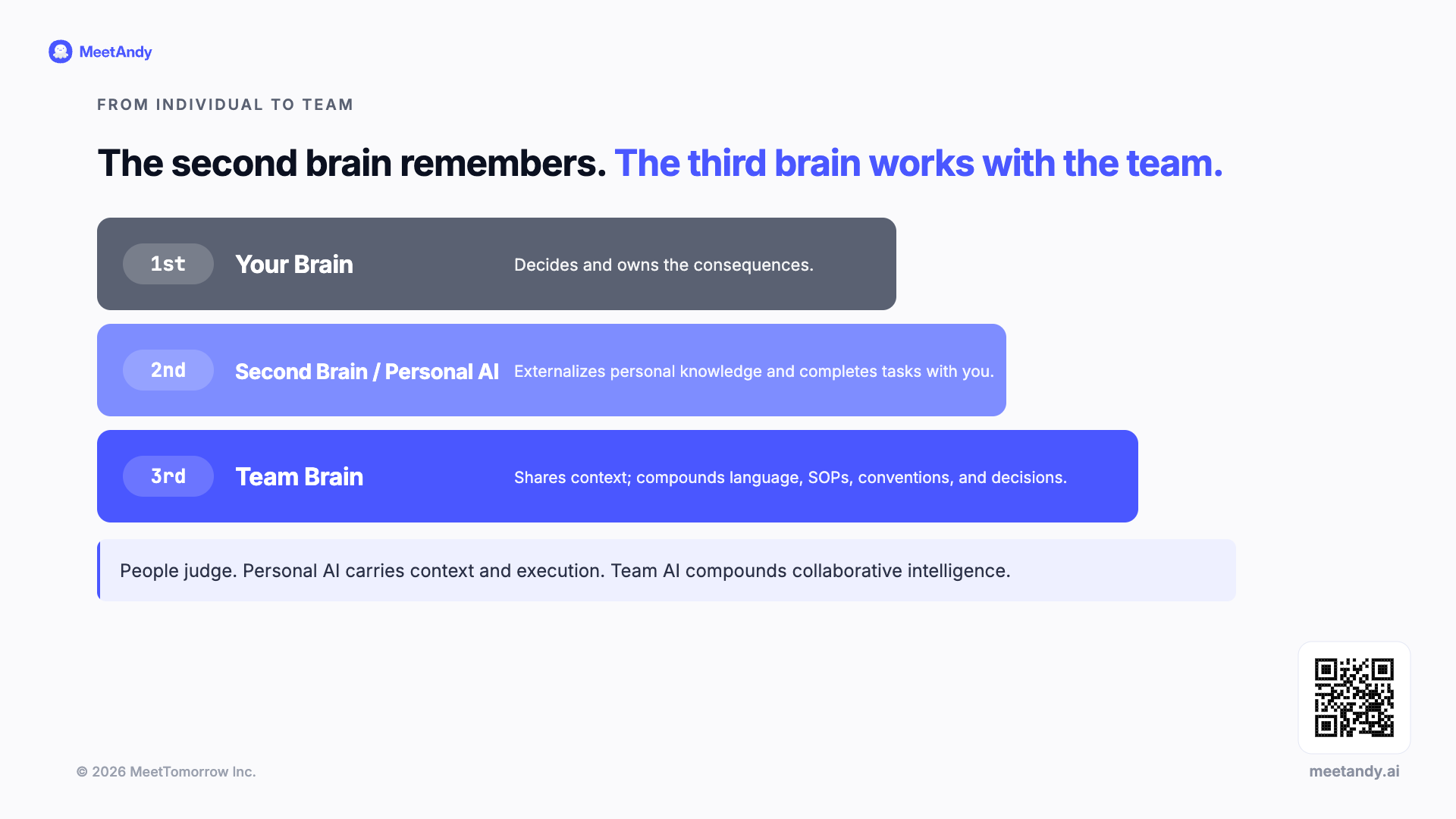
I think of ChatGPT, Claude, and Aria as second brains. They externalize personal knowledge and automate individual workflows. They make each person faster.
But when every role brings its own second brain to the team, the handoffs remain.
Everyone Has AI. Delivery Still Gets Stuck at the Handoffs
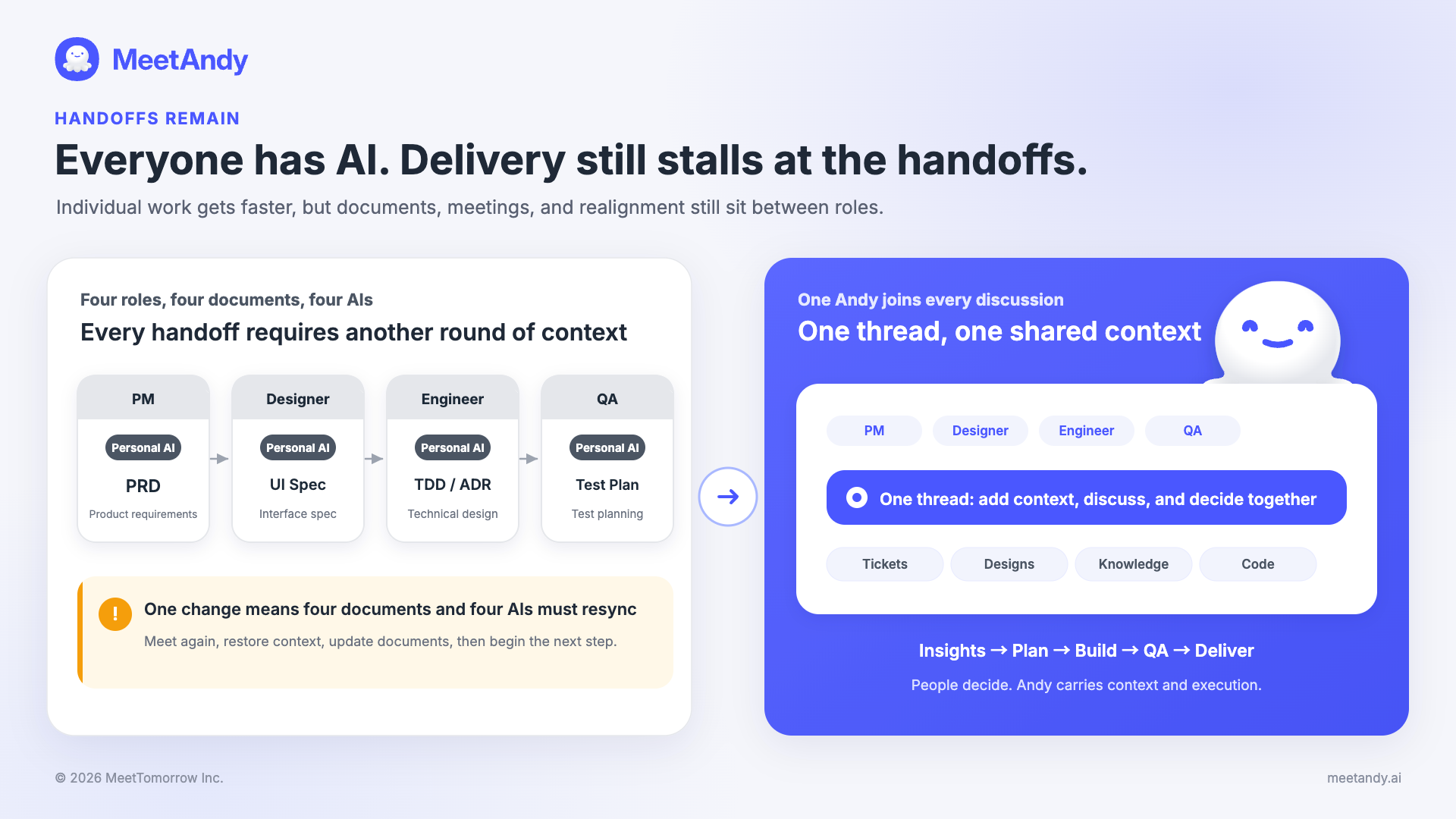
Before AI, building a product feature usually began with a product manager writing a product requirements document (PRD), then meeting with a designer, an engineer, and a QA engineer to discuss it. The designer produced the design, the engineer planned the implementation, and the QA engineer prepared the test plan.
Now everyone has their own AI:
- The PM uses AI to draft the PRD, then still meets with the designer, engineer, and QA engineer to confirm the requirements.
- The designer feeds the PRD and meeting notes into their AI to produce designs and a UI specification, then goes back to the PM to confirm that the screens and interactions match the intent.
- The engineer asks their AI to read the PRD, designs, and codebase, then produce a technical design document and an architecture decision record (ADR). The engineer and PM still go back and forth on scope, constraints, and tradeoffs.
- The QA engineer asks their AI to read the same documents and draft a test plan, then meets with the PM, designer, and engineer to confirm acceptance criteria and edge cases.
Every role works faster, but everyone still returns to the meeting with their own documents and their own AI. Whenever the discussion changes the requirement, all of those documents need to be updated and fed back into separate AI conversations.
Each AI sees its own set of documents, not the full discussion. Architectural constraints, interview context, specification tradeoffs, and changes to acceptance criteria remain scattered across different people’s heads.
Whenever one part is ambiguous, the team has another meeting, writes another document, or explains the same context to every AI again.
AI has accelerated the work within each role. It has not removed the handoffs between roles. Product delivery still gets stuck in the same place.
I often joke that a PRD is a page whose only job is to get people on the same page.
But as soon as everyone goes back to their own AI, the team is back on different pages. Each AI has a different conversation history, memory, and set of sources. At the next handoff, the team has to align all over again.
If those individual AIs could become one shared team AI, much of that friction would disappear.
This does not mean sharing one ChatGPT account. It means having the same AI teammate participate in the team’s discussions: where the requirement came from, why the specification changed, which technical constraints the engineer raised, and which version the team finally approved.
That is the third brain.
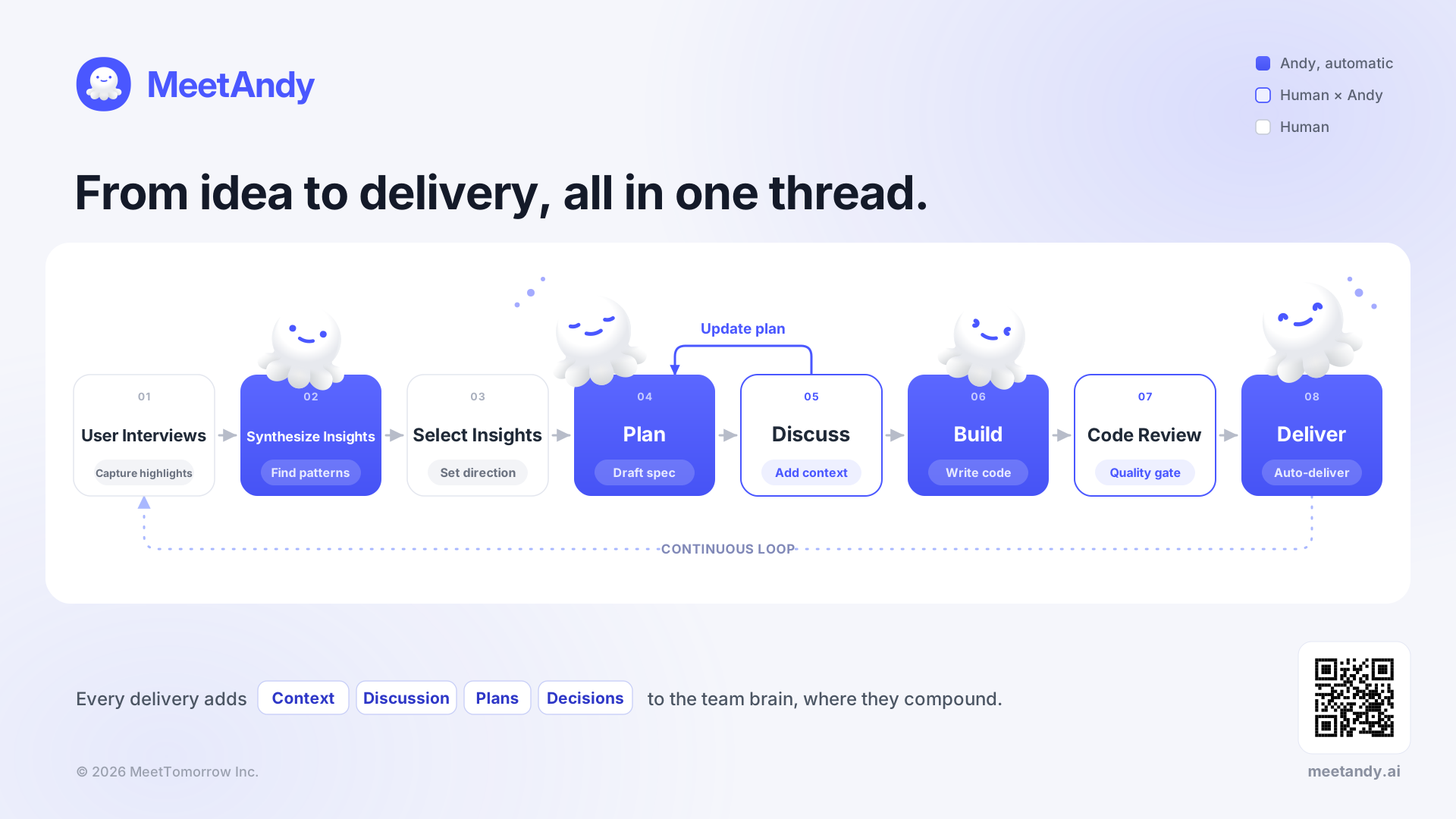
From Idea to Delivery, All in One Thread
MeetAndy is the AI teammate that takes your team from idea to delivery in one thread. Every delivery compounds into your team’s brain.
MeetAndy supports Slack and Google Chat, and connects to the tools the team already uses: tickets in Jira; knowledge in Google Drive, Notion, Guru, or Confluence; and code in GitHub or GitLab. Andy can read from those systems and write plans, updates, and summaries back to them.
PMs, designers, engineers, and QA engineers no longer need to feed the same PRD into separate AIs and exchange outputs that have lost their context. Everyone can add information, ask questions, and adjust the direction in the same thread.
Because Andy participates in the original discussion, it knows who added which piece of context, why the plan changed, and which version was ultimately approved.
People choose which insights to act on, weigh tradeoffs, make the final call, and review the work. Andy organizes the information, drafts the plan, posts updates, executes the work, and preserves the record.
The Full Workflow Is a Loop
A piece of work may begin with a user interview, a support ticket, an unexpected metric, or a request from the sales team.
-
Synthesize the insights
Andy reads interview notes and other data points, then identifies recurring problems, possible opportunities, and questions that still need answers.
AI can do the heavy reading and synthesis. The team still decides which insights are worth acting on.
-
Build the plan together
Once the team has chosen a direction, Andy drafts a plan with the known constraints, missing information, and expected implementation approach. The PM, designer, and engineer add their context in the same thread.
Andy also rates each plan for risk and complexity, surfacing technical considerations a PM may not know to ask about. Engineers can contribute knowledge that previously existed only in their heads, such as a limitation in the underlying architecture and why a different approach would work better. The team can adjust the implementation and acceptance criteria before anyone writes the first line of code.
-
Andy keeps the team updated
Throughout the discussion, Andy updates the plan, decisions, and outstanding tasks. Anyone joining later can understand the current state without reading every message or asking someone else to write a status summary.
-
Start building once the plan is approved
Andy can implement, test, and open a pull request for a straightforward web feature.
For mobile apps or work that depends on a local development environment, Claude Code or Codex can connect to Andy, retrieve the approved plan, and carry it out locally. The discussion and plan remain in the team’s thread, while implementation happens in the environment best suited to the work.
-
People own QA, review, and release
Andy can do the work, but people still own QA, code review, and the final release decision. Once the feature ships, new usage data and interview feedback return to the beginning of the process.
Taken together, the workflow forms a loop.
Insights become a plan. The plan becomes a product. The product produces new data and user feedback. When the next cycle begins, Andy already knows what the team discussed, what it tried, and why it made those decisions.
In one customer interview, a PM described spending three to five days repeatedly asking engineers questions and filling in tickets one by one. Now the PM can complete most of the planning with Andy, while engineers join only when technical judgment or review is needed. The customer estimated that planning time fell by about 70%, and engineers were no longer interrupted by the same basic questions.
We use Andy to build MeetAndy itself. As of August 2026, all MeetAndy code is generated by AI, with about 40% delivered directly by Andy. Our website, user documentation, and support workflow use the same model.
Every Delivery Feeds the Team Brain
Andy participates in the discussion behind every delivery and every code change. It retains the context behind each requirement: how it took shape, why the plan changed, and which tradeoffs the team made.
Nobody wants to be permanently responsible for remembering how the team works. The job is tedious, and every process change creates more documentation to maintain.
Andy learns by looking back at the work itself. When someone says, “No, that’s not how we do it. Do it this way,” Andy records the correction and its context. The next time a similar question appears, the team does not have to wait for the same person to correct it again.
A third brain also does not require dumping every historical company document into a search system. In software development, the code is usually the most up-to-date source of truth. Andy scans the code first, then pulls in relevant documents only when a task calls for them.
When Andy finds a source, it cites it. When it cannot find one, it says so. The team can then give it the context it needs: rollback procedures, backlog history, team responsibilities, project documentation, and working rules. Its memory grows through real work rather than a one-time import.
This also changes how the team learns to use AI. Andy works in open channels, where people can see how others ask questions, how the AI responds, and where experienced teammates add judgment. Techniques that used to be hidden in individual prompts become something the whole team can learn from in the open.
Over time, Andy should understand the team better and remove more friction from each new delivery.
That is MeetAndy’s flywheel: every delivery compounds knowledge into the team’s brain, so it gets smarter with use.
Once the team can carry context from one delivery into the next, the economics of product development begin to change.
As development capacity increases, the way teams build products will change.
In the past, a team facing three possible solutions might have chosen the cheapest one. When implementation costs fall, it can build all three and run a fast A/B test. The more important questions become: How quickly can we get the results back? Can the team understand what happened? Can it turn what it learned into the starting point for the next piece of work?
I see this as another kind of digital transformation. Software companies used to help their customers transform. Now they have to transform themselves.
Engineers will spend more time building infrastructure and guardrails so other roles can create things safely. Designers will encode more judgment in design systems. PMs will choose the problems that are genuinely worth solving and turn the team’s new speed into revenue, better products, or faster learning.
A second brain makes each person faster.
A third brain lets people and AI work from the same context, removes handoff friction, and carries the whole product from idea to delivery.
If handoffs are still slowing down your product delivery, let’s talk.